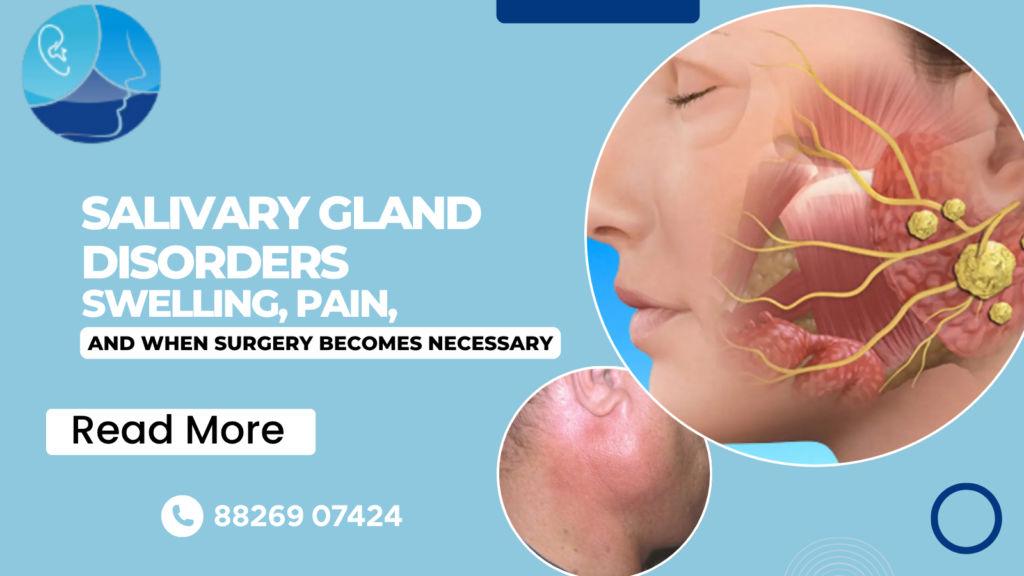
You probably never think about your salivary glands — until they start causing trouble. These small but remarkably important glands work silently every day, producing the saliva that keeps your mouth moist, begins digestion, and protects your teeth from bacteria. When they malfunction, the symptoms can range from mildly uncomfortable to genuinely debilitating. best ENT doctor in Rohini
Salivary gland disorders are more common than most people realise, and they are frequently misunderstood or left untreated for too long. Understanding what can go wrong, why it happens, and when medical or surgical intervention becomes necessary could save you from weeks of unnecessary pain. best ENT doctor in Rohini
Understanding Your Salivary Glands
You have three pairs of major salivary glands — the parotid glands (located near the ears and jaw), the submandibular glands (beneath the lower jaw), and the sublingual glands (under the tongue). Hundreds of smaller minor salivary glands also line the mouth and throat. best ENT doctor in Rohini
Together, they produce up to one litre of saliva daily. Saliva is not just water — it contains enzymes, antibodies, and proteins essential for digestion, immune defence, and oral health. Any disruption to these glands affects far more than comfort. best ENT doctor in Rohini
Common Salivary Gland Disorders
1. Salivary Stones (Sialolithiasis)
The most common salivary gland disorder, salivary stones, forms when minerals in saliva crystallise and block the ducts through which saliva flows. The submandibular glands are affected most frequently. best ENT doctor in Rohini
Symptoms include:
Sudden, intense pain and swelling beneath the jaw or near the ear, particularly during meals when saliva production surges
A hard, pea-sized lump felt under the jaw or on the floor of the mouth
Difficulty swallowing or opening the mouth fully
Dry mouth due to blocked saliva flow
Small stones sometimes pass on their own with hydration and gentle massage. Larger ones require professional removal — through manual extraction, minimally invasive endoscopy, or in stubborn cases, surgery. best ENT doctor in Rohini
2. Sialadenitis — Salivary Gland Infection
When a duct becomes blocked,d or saliva flow slows — common in dehydrated or elderly patients — bacteria can travel upstream and infect the gland. This condition, called sialadenitis, can be acute or chronic. best ENT doctor in Rohini
Symptoms include:
Rapid swelling of the affected gland
Redness and warmth over the cheek or jaw
Fever and general unwellness
Pus discharge into the mouth in severe cases
Painful to touch or chew
Acute bacterial sialadenitis typically responds well to antibiotics, hydration, and warm compresses. However, recurrent or chronic infections often signal an underlying structural problem — such as a narrowed duct or persistent stone — that may eventually require surgical correction.
Patients across Rohini Sectors 16, 17, and 24 dealing with recurring jaw swelling and infections are encouraged to visit the best ENT doctor in Rohini for an accurate diagnosis rather than repeatedly relying on antibiotics alone. best ENT doctor in Rohini
3. Salivary Gland Tumours
Most salivary gland tumours — around 75–80% — are benign. The most common is the pleomorphic adenoma, a slow-growing, painless lump usually appearing near the ear or jaw. Though non-cancerous, benign tumours must be monitored closely because a small percentage can become malignant over time.
Malignant tumours, though less common, grow faster, may cause facial nerve weakness or numbness, and can spread to lymph nodes.
Warning signs of a salivary gland tumour:
A persistent, painless lump near the ear, jaw, or under the chin
Facial asymmetry or drooping
Numbness or tingling in the face
Difficulty opening the mouth fully
Any unexplained lump in the head and neck region lasting more than two to three weeks warrants urgent evaluation by the top ENT surgeon in Rohini.
4. Sjögren’s Syndrome
Sjögren’s syndrome is an autoimmune condition in which the immune system attacks the salivary and tear glands, dramatically reducing their output. It predominantly affects women over 40 and can occur independently or alongside other autoimmune diseases like rheumatoid arthritis. best ENT doctor in Rohini
Key symptoms:
Persistent dry mouth and difficulty swallowing dry foods
Dry, gritty eyes
Enlarged parotid glands causing facial puffiness
Joint pain and fatigue
Increased dental decay due to reduced saliva
Management is largely supportive — saliva substitutes, prescription medications to stimulate saliva, meticulous dental care, and treatment of associated autoimmune conditions.
5. Viral Infections — Mumps and Beyond
Viral infections, most famously mumps, can cause significant swelling of the parotid glands. While childhood vaccination has made mumps rare, it still occurs in unvaccinated individuals. Other viruses, including Epstein-Barr, HIV, and influenza, can also affect the salivary glands. best ENT doctor in Rohini
Viral salivary gland swelling is typically bilateral (both sides), accompanied by fever and general malaise, and resolves with rest and supportive care. best ENT doctor in Rohini
When Does Surgery Become Necessary?
Not every salivary gland problem requires an operation — but several situations make surgery the most appropriate path forward.
Surgery is typically recommended when:
A salivary stone is too large to pass or be removed endoscopically
Chronic, recurrent sialadenitis has damaged the gland beyond recovery
A benign tumour is growing, causing discomfort, or carries a malignant risk
A malignant tumour is confirmed or strongly suspected on imaging and biopsy
A duct stricture (narrowing) is causing repeated blockages unresponsive to dilation
The most common surgical procedures include parotidectomy (removal of the parotid gland), submandibular gland excision, and sialendoscopy — a minimally invasive technique using a tiny camera to clear blocked ducts without open surgery.
Sialendoscopy has revolutionised treatment for stones and duct strictures, dramatically reducing recovery times and preserving gland function. The best ENT doctor in Rohini can determine whether this minimally invasive approach is appropriate for your specific condition.
Diagnosis — What to Expect
A thorough evaluation typically includes a physical examination of the neck, jaw, and mouth, followed by imaging. Ultrasound is usually the first-line imaging tool for identifying stones and gland enlargement. MRI or CT scans provide detailed images of tumours and deep gland involvement. Fine needle aspiration (FNA) biopsy may be performed if a tumour is suspected.
Residents of areas like Rohini Sector 3, Prashant Vihar, and Pitampura who experience recurrent jaw swelling, persistent dry mouth, or unexplained facial lumps should not delay seeking assessment from the top ENT surgeon in Rohini — early diagnosis consistently leads to simpler, more effective treatment.
Conclusion: Don’t Dismiss What Your Jaw Is Telling You
Salivary gland disorders span a wide spectrum — from easily treatable stones and infections to complex tumours requiring surgery. The common thread across all of them is this: early evaluation leads to better outcomes with less invasive treatment.
If you have noticed persistent swelling near your jaw or ear, repeated episodes of pain during meals, unusual lumps in the neck, or a chronically dry mouth, your salivary glands may be asking for help. Listen to them.
A small lump ignored today can become a complex surgery tomorrow — see your specialist early.
FAQs
Q1. Can salivary stones go away on their own?
Small stones sometimes pass with increased hydration, warm compresses, and gentle massage. Larger ones usually need medical or surgical removal.
Q2. Is salivary gland surgery dangerous?
Modern techniques are safe. The main risk with parotid surgery is temporary or permanent facial nerve involvement, which an experienced ENT surgeon works carefully to avoid.
Q3. How is a salivary gland tumour diagnosed?
Through physical examination, ultrasound or MRI imaging, and fine needle aspiration (FNA) biopsy to determine whether the tumour is benign or malignant.
Q4. Can salivary gland infections recur?
Yes. Recurrent infections often indicate an underlying structural issue, like a stone or duct narrowing, that needs to be addressed to prevent further episodes.
Q5. What is sialendoscopy?
Sialendoscopy is a minimally invasive procedure using a tiny camera inserted into the salivary duct to locate and remove stones or clear blockages without open surgery.